

Smart manufacturing is entering a decisive phase as factories transition from fixed processes to adaptive, connected environments that interpret and respond in real time. Plants equipped with IoT-enabled machines, edge computing, digital twins and AI-led quality systems are closing the gap between planning and execution. Production teams now optimize throughput, predict failures and coordinate workflows with precision that seemed unattainable just years ago.
Welding illustrates this transformation vividly. Still central to automotive, infrastructure, energy and aerospace manufacturing, the discipline is being reshaped by robotics, automated inspection, continuous data capture and AI supported controls. Precision welds that once depended on manual craft are increasingly guided by algorithms that measure arc stability, penetration depth and heat behavior as each bead forms.
Training must evolve accordingly. Modern programs incorporate simulation platforms, VR practice, digital twins of weld cells and data informed learning pathways that mirror smart factory operations. Learners receive continuous feedback, real-time analytics and safer skill development, preparing them for workplaces where digital fluency matters as much as technical ability.
The momentum is undeniable. Smart factories cannot reach their potential without a workforce trained to match their intelligence. Machines accelerate efficiency; skilled people determine how that intelligence is applied. The smart manufacturing market is projected to grow from $394.35 billion in 2025 to $998.99 billion by 2032, at a 14.2 percent CAGR.
The magazine features Walter Pesenti, VP of Manufacturing Excellence and Kyler Tebbutt, Director of Digital Factory Operations at NOVA Chemicals, discussing why people, culture and leadership ultimately shape the success of digitalization in manufacturing. An article by Yohann Rousselet, Global Director of Technology Innovation at Baltimore Aircoil Company, explores how additive manufacturing accelerates innovation through rapid prototyping, faster testing and breakthrough design advancements that significantly shorten development timelines across HVAC and industrial applications.
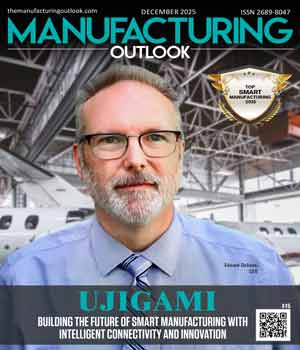
The cover story spotlights Ujigami, an innovation-driven technology company that unifies fragmented factory systems through intelligent connectivity, empowering manufacturers with real-time decision-making, seamless automation and a flexible platform that modernizes operations without costly infrastructure overhauls.
We hope this edition inspires manufacturers, educators and technology leaders to embrace this transformation with confidence, recognizing that the future of industry will be built by intelligent systems and the skilled people who guide them.